
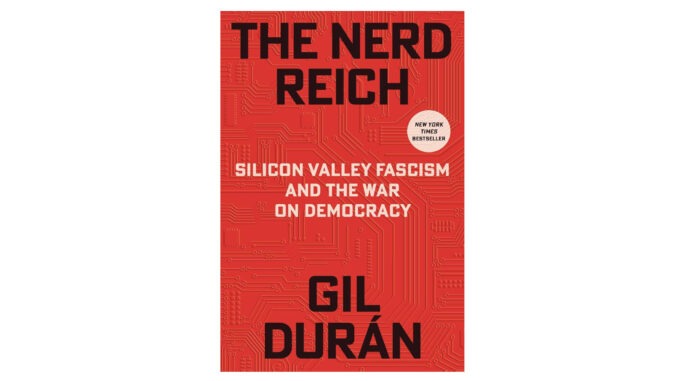
Anyone who has spent time in cybersecurity has likely sat through a threat modeling exercise. You figure out who the adversaries are, what they want, what tools they have, and where your defenses are weakest. Most of the time it’s a planning exercise for an attack that may or may not ever come.
Gil Durán’s The Nerd Reich: Silicon Valley Fascism and the War on Democracy reads like a threat model for American democracy, except the attack is already underway and the adversaries spent years publishing their intentions in blog posts, podcasts, investor letters and book prefaces. Durán went and read all of it so the rest of us don’t have to. I just finished it, and I think it’s one of the most important books of the year.
Durán Did the Homework
Durán starts with The Sovereign Individual, a 1997 book by James Dale Davidson and William Rees-Mogg that predicted crypto and digital technology would erode the power of nation-states. Peter Thiel wrote the preface when it was reissued in 2020. From there, Durán follows the thread through Curtis Yarvin’s neoreactionary writing, Balaji Srinivasan’s network state concept, and the venture capital money that turned fringe ideas into real political projects, from San Francisco’s 2022 recall elections all the way to the White House.
The research is exceptionally detailed, and most of the damning material comes straight from the people involved. Thiel wrote back in 2009 that he no longer believed freedom and democracy were compatible. Durán doesn’t have to embellish much. He mostly lets these men speak for themselves and then connects the dots between who funded whom, who mentored whom, and who ended up in power. Thiel was the main patron of JD Vance’s political career, for example, and Vance is now the vice president.
Other reviewers have raised a few fair points. Laura Miller at Slate noted there isn’t much original reporting in the book, and that Durán mostly pulls together the work of many journalists and scholars. Ali Winston at The Baffler felt the sheer scope sometimes works against it, and The New York Review of Books argued that Durán overstates his case when he says we can have billionaires or democracy but not both. I don’t see the synthesis as a weakness, though. Most people aren’t going to wade through Yarvin’s blog archive or sit through hours of Srinivasan’s podcast appearances. Having it all in one place, with sources, is the value. Miller described the book as a much-needed aid in “tearing down the golden calf Americans have built in Palo Alto,” and I agree with her.
We’re Living in the Consequences
Reading this book in October 2026 is a little unsettling, because the news keeps adding chapters. Thiel and Musk weren’t elected to anything, yet they wield extraordinary influence over US and global policy.
Musk ran DOGE, which tore through federal agencies and their data with very little oversight. Palantir, the data analytics company Thiel co-founded, has contracts with Immigration and Customs Enforcement (ICE) worth nearly $140 million. Thiel’s venture firm, Founders Fund, also invested in Flock Safety, whose license plate reader cameras now sit on poles in cities across the country, and federal agencies have been able to search that data. The concern crosses party lines, too. Republican Senator Josh Hawley opened an investigation into Flock’s data practices in August.
Put on your security hat and look at that as a system. It’s a lot of sensors feeding a handful of private consoles, and the people sitting at those consoles don’t answer to voters.
A Few People Own the Pipes
Surveillance is only part of it. Look at who controls the channels most Americans use to get their information. Musk owns X. Mark Zuckerberg controls Meta, which means Facebook, Instagram, and WhatsApp. Paramount Skydance, run by Larry Ellison’s son David and backed by Ellison family money, closed its acquisition of Warner Bros. Discovery on October 6. That puts CBS, CNN, HBO, MTV, BET, TNT, TBS and Discovery under one roof, and Larry Ellison’s Oracle also holds a stake in the joint venture that runs TikTok in the US. When the same small group owns the platforms, the newsrooms and the infrastructure, it doesn’t take an elaborate conspiracy to tilt things. It just takes a decision.
The last couple of weeks offered a few examples. Ukraine said its access to Starshield, the military version of SpaceX’s Starlink, was suddenly throttled, disrupting drone operations and air defenses the country depends on against Russia. Musk claimed the US military controls those speeds, but the Wall Street Journal reported, citing US officials, that the order came from Musk himself after he discussed it with senior Trump administration officials. Service has since been restored, but for a stretch of time one private citizen’s choices left a country at war more exposed to its invader.
On October 17, Meta suspended the No Kings Coalition’s main Instagram account for roughly 90 minutes while nearly 3,000 early voting events were underway around the country, and organizers were locked out of posting for hours afterward. Meta said an automated system flagged the account’s high activity by mistake, and it apologized. Maybe that’s exactly what happened. Either way, a single company decided when one of the largest protest movements in the country could talk to its supporters, and Senator Chris Van Hollen is now demanding answers from Zuckerberg.
It doesn’t stop at the border, either. French prosecutors opened a criminal investigation into whether X’s algorithm was used for foreign interference, and France’s foreign minister accused Musk this month of orchestrating harassment campaigns against European leaders while warning about threats to the 2027 presidential election. EU officials also scrutinized X’s algorithm after Musk openly campaigned for Germany’s far-right AfD party. X denies using its algorithm to sway political opinion.
Buying a Senate Seat in Texas
I live in Texas, so this part hits close to home. Musk spent more than $250 million helping elect Donald Trump in 2024, and he isn’t slowing down. Federal filings show he gave $158 million in September to the Senate Leadership Fund, which passed the same amount straight through to Texas PAC, a super PAC backing Ken Paxton’s Senate run against James Talarico. According to The Hill, Musk was the only donor to Texas PAC in the third quarter, and his own America PAC has spent another $7.5 million supporting Paxton. Money alone does not (or at least should not) decide an election, but that’s one unelected billionaire paying for most of the outside effort to pick a US senator for my state.
Worth Your Time
I’m almost finished with Chain of Ideas: The Origins of Our Authoritarian Age by Dr. Ibram X. Kendi, and reading the two books back-to-back has been eye-opening. On paper, they tackle completely separate systemic problems. Kendi traces great replacement theory, the idea that demographic change is an existential threat that only a strongman can stop, from its roots centuries ago to its spread through politics around the world today. Durán follows tech money and the ideology of a handful of billionaires who see democracy as something to route around. If you drew a Venn diagram of what’s wrong with the world right now, though, those two circles would overlap a lot. Both books trace fringe ideas that found powerful backers, and both arrive at the same place, with fewer checks on power and a strongman to cut through the ones that are left.
Durán lays out this movement in more detail than anything else I’ve read, and the book holds up whether or not you agree with the use of the word “fascism.” The quotes, the money trails, and the business relationships are all there for you to check. You don’t have to agree with every conclusion to come away understanding how much power has concentrated in a few hands, and how little say any of us had in it. If you still think of these guys as quirky inventors who happened to get rich, read this book.

Leave a Reply