
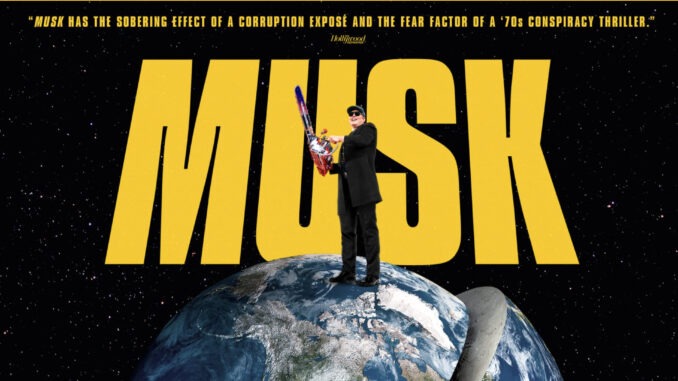
PT Barnum didn’t create Jumbo the elephant. He bought him from the London Zoo in 1882 and convinced America it needed to pay to see the biggest animal anyone had ever seen. Barnum’s real talent was never zoology. It was the ticket booth.
That’s the Elon Musk who shows up in Alex Gibney’s documentary Musk, which I saw last night. Tesla and SpaceX are real companies that have done significant things, and the film doesn’t pretend otherwise. What it does, over almost four hours with an intermission, is make a pretty convincing case that Musk’s real gift is buying the elephant and selling the tickets.
Selling the Show
Most people think of Musk as the founder of Tesla. Martin Eberhard, who started the company with Marc Tarpenning, holds up the incorporation papers in the film and points out that Musk’s name isn’t on them. Musk came in as the lead investor, eventually pushed Eberhard out, and settled the lawsuit that followed on terms that let him call himself a founder. Eberhard explains it with a line that says a lot about Silicon Valley: “There’s no legal definition of ‘founder.'”
The pattern repeats from there. According to the film, a battery swap demo helped Tesla land subsidies in California even though battery swapping never really became a thing. Gibney revisits the 2016 video of a Tesla driving itself, which former Tesla staff say was staged, and pairs it with dash-cam footage of fatal crashes that is hard to watch. Gibney told Democracy Now! that Musk is “an investor, not an inventor.” I’d go a step further and call him a promoter, and a very good one.
To be fair, the film gives credit where it’s due. A NASA official says SpaceX saved the agency a lot of money, and Gibney acknowledges Musk’s business savvy. He just doesn’t confuse that with engineering genius, and neither do I.
The Elizabeth Holmes Comparison
Last week I saw You Can See Everything, the Elizabeth Holmes documentary from Nathan Fielder and Lance Oppenheim. It’s a masterpiece, and it turns out to be a strange companion piece for Musk. Holmes invited the film crew into her home 34 days before she reported to prison, and Fielder spends much of the movie trying to figure out whether anything she says is true. At one point she asks him why she would ever deceive him, and you honestly can’t tell if she believes it.
Holmes sold a vision of a machine that didn’t work, and she’s serving an 11-year sentence in a federal prison in Texas. Musk sold a car that could drive itself years before it actually could (and continued to repeat the same grandiose bait-and-switch for years), and his net worth kept climbing. The two cases aren’t legally the same, and I’m not claiming they are. Watching both films within a week, though, the difference in outcomes seems to come down to scale. Holmes had one product and ran out of runway. Musk had several companies, a soaring stock price, billions in government contracts, and eventually an office in the White House.
Where the Ideas Come From
I recently finished Gil Durán’s The Nerd Reich, and it gave me a useful frame for the second half of the film. Durán traces a strain of Silicon Valley thinking back to The Sovereign Individual, a 1997 book predicting that a tech elite could use digital money to escape the reach of governments. His cast includes Peter Thiel, Marc Andreessen, Balaji Srinivasan, and Musk. The book spends most of its time on Thiel, but Musk is the one with the biggest checkbook and the loudest megaphone.
Gibney actually pushes back on the ideology angle a bit. He told Democracy Now! that he sees Musk as pragmatic, liberal when he needed money from the Obama administration, and pro-Trump when he was facing a stack of federal investigations. I think both can be true. A guy can be an opportunist and still help drag dangerous ideas into the mainstream.
That’s where Ibram X. Kendi’s Chain of Ideas comes in. I’m finishing it this week. Kendi traces how the “great replacement” conspiracy theory moved from the fringe to the center of politics around the world. Musk has amplified versions of it on X, including a 2023 post where he endorsed an antisemitic replacement claim. “Musk” the movie shows some of the raw material without spelling it out. Errol Musk calmly describes shooting three black intruders. Justine Musk recalls someone on Elon’s side referring to the mothers of his children as “the breeders.” Kendi’s book explains where ideas like these lead when someone with a massive platform keeps pushing them.
Then there’s the money. The Supreme Court’s Citizens United decision in 2010 opened the door to unlimited outside spending, and Musk walked right through it. He gave nearly $300 million to help Donald Trump win in 2024, and The New York Times reports he has put more than $366 million into Republican groups and his own super PAC for this year’s midterms. I think Citizens United is a horrific decision. No single person should be able to buy that kind of influence over an election, and Musk is the clearest example of why.
DOGE, USAID, and Starlink
The end of the documentary is the hardest to sit through. It is the part that feels most visceral and poignant because we are still living through it and our country and the world continue to face the repercussions of it.
In February 2025, Musk bragged that DOGE had fed USAID into the wood chipper. Samantha Power, the agency’s former administrator, gets emotional on camera talking about what that means. A study published in The Lancet projected that the cuts could lead to more than 14 million additional deaths by 2030, including about 4.5 million children under five, if they aren’t reversed. That’s a projection, not a body count, but it’s a projection from one of the most respected medical journals in the world.
Kara Swisher notes in the film that many of the agencies DOGE went after, like the SEC and the FAA, were the same ones looking into Musk’s companies. Gibney believes that was the point. He admits he can’t prove all of it.
The film also looks at how Starlink turned Musk into an unelected player in the war in Ukraine. I read Walter Isaacson’s biography of Musk, which is where the Crimea story first came out. According to Isaacson, Ukrainian drone boats headed for the Russian fleet at Sevastopol in September 2022 lost their connection and washed ashore. Musk has said Starlink was never active over Crimea in the first place, and that he refused an emergency request to turn it on because he didn’t want to be complicit in a major act of war. Isaacson later acknowledged the service hadn’t been enabled there. Whichever version you accept, one private citizen decided where a country defending itself from invasion could and couldn’t fight.
Gibney finished the film before the latest chapter, which happened just over a week ago. On October 14, Ukrainian forces lost speed on Starshield, the military version of Starlink, without any warning. Ukrainian officials said the cap left some of their attack and interceptor drones close to useless, and it came right after Russian missile strikes on Kyiv killed at least nine people. Zelenskyy called it a big mistake that would cost lives. Musk posted on X that limits on speed or usage are decided by the U.S. military and ultimately the president. Trump said it wasn’t him, and that it probably wasn’t Musk either. Secretary of State Marco Rubio said the administration had no advance knowledge.
Then the reporting started to contradict Musk. The Telegraph, citing four sources, reported that Musk proposed the slowdown and Trump went along with it. The Wall Street Journal reported on October 20 that Musk ordered the limits himself after he and Trump got angry about Ukrainian drone strikes on Russian refineries. According to the Journal, SpaceX also reached out to the White House after the fact to agree on a public story that made the decision look coordinated. Accounts still differ on whether Trump was consulted ahead of time, and some U.S. officials told the Journal that Musk acted alone. It’s the same pattern Gibney spends four hours documenting, playing out in real time while the movie is in theaters.
I’m not a lawyer, and war crimes have specific legal definitions. Still, a private citizen making battlefield decisions for a nation at war, more than once, and an unelected official gutting programs that kept millions of people alive, both deserve a serious, independent investigation.
Is It Worth Four Hours
Mostly, yes. The AI avatar Gibney built to speak Musk’s own words sits right on the edge of the uncanny valley, and it’s distracting. Gibney also drifts into speculation a couple of times, like a scene built around a cryptic election night comment about lasers in space and the suggestion that DOGE data could be used to meddle in the midterms. NPR pointed out that neither idea is backed by evidence, and they’re the weakest moments in an otherwise well-documented film.
“You Can See Everything” is a better movie in my opinion. It’s stranger and more original, and it trusts you to reach your own conclusions. “Musk” plays more like a four-hour closing argument. It’s an important argument, though, and most of it is backed by the record. Elizabeth Holmes is sitting in a federal prison in Texas. According to the film, Musk is now one of the advisors on the Pentagon’s future of warfare initiative, and the military is using his Grok AI.

Leave a Reply