
I’ve been a Will Smith fan for a long time. Long before blockbuster franchises and Oscars, I was listening to DJ Jazzy Jeff & The Fresh Prince on repeat when I was in high school and was an avid watcher of “The Fresh Prince of Bel-Air.” I have closely followed his career as he has moved between music, comedy, and serious acting. Smith has always had range. He’s also always had curiosity.
Seeing him step into the role of nature and wildlife adventurer with National Geographic in “Pole to Pole with Will Smith” feels like a newer twist in that arc—but not an awkward one. I’m not surprised that Smith also excels in this space. What did surprise me, however, is how the series captured something that goes beyond storytelling altogether.
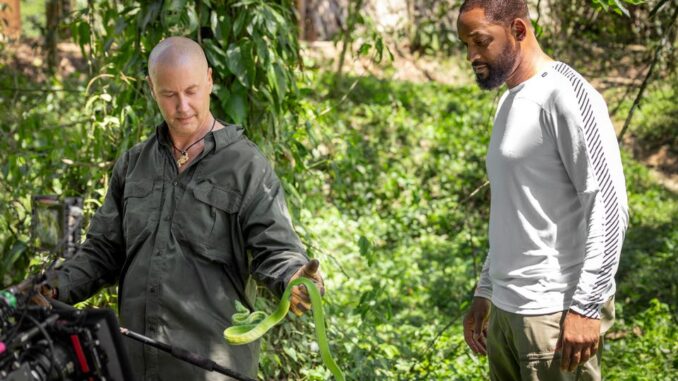
The Amazon episodes, especially “The Amazon: Dark Waters,” don’t just document a remote ecosystem. They capture real scientific discovery as it happens. While filming, Smith and world-renowned venomologist Bryan Fry helped identify a previously undocumented species of anaconda. At the same time, Fry’s research uncovered something far more troubling: heavy-metal contamination moving through the Amazon food chain, likely tied to oil activity upstream.
That pairing—discovery and damage—is what makes these episodes matter.
Rethinking What We Think We Know About Anacondas
Most people think they know anacondas. In reality, what we “know” is filtered through pop culture. I sat down with Fry to talk about “Pole to Pole” and what they found on their trek in the Amazon, and noted that most people think anacondas are scary monsters thanks to Hollywood. Fry joked with me that the movie Anaconda remains one of his guilty pleasures, but the real animals couldn’t be more different from their cinematic reputation. More importantly, they play a critical role in river ecosystems.
Fry told me that what makes this newly identified species so interesting isn’t just that it’s new. It’s the extreme sexual dimorphism. The females are what people expect: massive, powerful apex predators. The males, however, are much smaller, lighter, and hunt very differently. That difference turned out to be scientifically invaluable.
Fry told me the expedition “ended up being almost like a textbook case of showing the value of basic science.” On the surface, splitting one anaconda species into two genetic lineages might seem academic. In practice, it unlocked a way to understand what is entering the ecosystem—and who is most at risk.
Apex Predators As Environmental Warning Systems
Because male anacondas feed higher up the food chain, Fry suspected they might act as biological sentinels. Testing confirmed it. The males carried dramatically higher concentrations of heavy metals like lead and cadmium—more than ten times the levels found in females in some cases.
Those metals don’t disappear once an oil spill fades from view. They persist. They accumulate in plants, then prey animals, then predators. Once they’re in the system, they stay there.
That’s where the story shifts from snakes to people. Apex predators don’t just reflect ecosystem health—they magnify problems that already exist. If contaminants are showing up in anacondas, they’re moving through the entire river system. That has implications for wildlife, biodiversity, and indigenous communities who rely on the river for food.
Discovery Alongside Disruption
Fry described the Amazon expedition as “the most bittersweet” experience of his career. He had dreamed of working with the Waorani people since childhood. Instead, he found a community and ecosystem being impacted by forces far beyond their control. “It was a dream come true and a nightmare all at the same time,” he said.
One of the most important insights from Fry’s work is that environmental risk doesn’t stay local. Migratory fish move contaminants between regions. Rivers function as interconnected systems. Pollution travels. Communities far from drilling sites can still face exposure without ever seeing the source.
Rather than framing this as an unsolvable political problem, though, Fry focused on what he called “the art of what is possible.” His goal is practical: develop wild-food safety guidance that helps communities reduce risk without eliminating vital sources of protein. That kind of work doesn’t make headlines, but it changes lives.
What The Camera Can’t Fully Capture
“Pole to Pole” also illustrates something most documentaries struggle to convey: how unpredictable field science really is. You start with a hypothesis. You end with more questions. Ecosystems overlap. Cause and effect rarely move in straight lines.
Fry pointed to one cave system as an example. Its entire ecosystem exists because oil birds nest deep underground. If those birds disappear elsewhere due to habitat loss, the cave collapses. Along with it goes untapped biological potential—including venom compounds that could one day become life-saving drugs.
That’s the argument “Pole to Pole” makes quietly but effectively. Conservation isn’t just about preserving beauty. It’s about protecting options we don’t yet understand.
When Access Amplifies Science
Will Smith’s role in all of this isn’t to explain the science or overshadow it. It’s to create access—to places, people, and attention—that most researchers never get. In the Amazon episodes, that attention amplifies expertise rather than replacing it.
The lasting impact of “Pole to Pole” won’t be measured by views or scenery. It will be measured by whether audiences understand that discovery and degradation often arrive together—and that the Amazon still holds secrets we’re only beginning to uncover.




Leave a Reply